
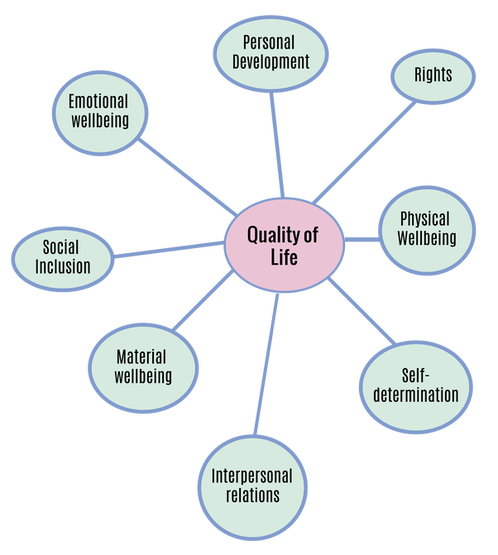
Quality of Life is a complex concept related to an individual's general wellbeing regarding health, comfortability, and ability to partake in desired life activities. It is associated with many facets. However, Schalock's comprehensive review identifies eight core domains (1).
who's to decide what one's quality of life is?
Enhancing the quality of life of disabled individuals through self-advocacy, research, policy rejects viewing disabled individuals by their deficiencies in favor of embracing their diversity. Many quality of life issues stem from public perception and historic stereotypes of disabled individuals. Society’s high quality of life standards tend to skew toward the wealthy, white, cisgender male. Longstanding stereotypes misconstrue disabled individuals to have a lower quality of life than non-disabled people. However, in fact disabled quality of life is comparable to that of non-disabled.
This can be problematic as quality of life judgments can be left in the hands of individuals such as providers who may have preconceived beliefs surrounding disability. An NPR article published in April 2020 claims, “Dr. Lisa Lezzoni, a physician and researcher at Harvard Medical School recently conducted a nationwide survey that aimed to assess doctors' attitudes about disability. A ‘vast majority’ rated the quality of life of people with significant disabilities as a little to a lot worse than that of others.” Providers might be less likely to intervene if they deem someone as having a poorer quality of life. However, quality of life priorities can NOT and should not be deemed by the provider. As a value judgment, it should be a decision for family/caregivers or the patient themself.
To enhance the overall wellbeing of disabled individuals, we must dismantle misconceptions and create accommodations striving for higher quality of life. Understanding and studying the different facets of quality of life presents a framework for a psychosocial approach to healthcare. Providers have a responsibility to protect and strengthen, rather than to diminish, their disabled patients’ quality of life.
This can be problematic as quality of life judgments can be left in the hands of individuals such as providers who may have preconceived beliefs surrounding disability. An NPR article published in April 2020 claims, “Dr. Lisa Lezzoni, a physician and researcher at Harvard Medical School recently conducted a nationwide survey that aimed to assess doctors' attitudes about disability. A ‘vast majority’ rated the quality of life of people with significant disabilities as a little to a lot worse than that of others.” Providers might be less likely to intervene if they deem someone as having a poorer quality of life. However, quality of life priorities can NOT and should not be deemed by the provider. As a value judgment, it should be a decision for family/caregivers or the patient themself.
To enhance the overall wellbeing of disabled individuals, we must dismantle misconceptions and create accommodations striving for higher quality of life. Understanding and studying the different facets of quality of life presents a framework for a psychosocial approach to healthcare. Providers have a responsibility to protect and strengthen, rather than to diminish, their disabled patients’ quality of life.
|
Eight Core Domains of Quality of Life (clockwise):
|
Sources
(1) Schalock, R. L. (2004). The concept of quality of life: What we know and do not know. Journal of Intellectual Disability Research: JIDR, 48(Pt 3), 203–216. https://doi.org/10.1111/j.1365-2788.2003.00558.x
