Power in Question |

|
The COVID-19 pandemic has been a disheartening display of increased patient-provider power dynamic challenges for disabled individuals. In a time where there is a shortage of life saving equipment, doctors have been forced to decide who lives and who dies.
As such, the Office Civil Rights announced care rationing guidelines for vulnerable groups including disabled individuals. However, when faced with real life decisions that must be made quickly in overwhelmed medical environments, it is harder to follow general guidelines. Throughout the pandemic, disabled individuals have feared that when doctors are forced to make this choice between life or death, the prejudice and stigma that their lives are invaluable or less valuable will prevail. The public and the medical community are using the presence or absence of disability to exclude people from necessary care.
As such, the Office Civil Rights announced care rationing guidelines for vulnerable groups including disabled individuals. However, when faced with real life decisions that must be made quickly in overwhelmed medical environments, it is harder to follow general guidelines. Throughout the pandemic, disabled individuals have feared that when doctors are forced to make this choice between life or death, the prejudice and stigma that their lives are invaluable or less valuable will prevail. The public and the medical community are using the presence or absence of disability to exclude people from necessary care.
The Story of Michael Hickson
Michael Hickson died at St. David’s South Austin Medical Center in Austin, TX on June 11. Mr. Hickson was a 46 year old Black man who had suffered sudden cardiac rest resulting in quadriplegia. He was using a BiPap machine to help push air into his lungs in the ICU after contracting pneumonia. His medical team, after getting approval from his medical guardian who isn’t his wife, decided to withhold treatment because his quality of life was too low. Melissa Hickson, Hickson’s wife, actually recorded the conversation with his doctor.
Doctor: So as of right now, his quality of life — he doesn’t have much of one.
Melissa: What do you mean? Because he’s paralyzed with a brain injury he doesn’t have quality of life?
Doctor: Correct.
Doctor: So as of right now, his quality of life — he doesn’t have much of one.
Melissa: What do you mean? Because he’s paralyzed with a brain injury he doesn’t have quality of life?
Doctor: Correct.
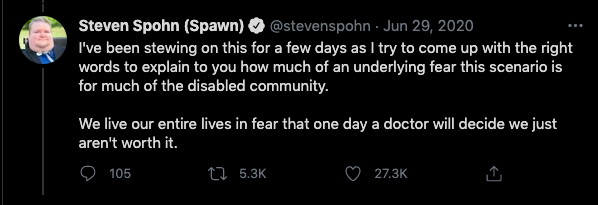
This is the response to Michael Hickson's death from a disabled individual, similar thoughts were echoed throughout twitter: the fear of being labeled "not worth it"
Since the time of Hickson's death, it has been revealed that the hospital didn’t need to ration care as it wasn’t overwhelmed with COVID-19 patients. The Chief Medical Office of St. David’s has said that Hickson had sepsis (life threatening response to infection), pneumonia in both lungs, and organ failure; none of which were mentioned in the video between Melissa and Hickson’s doctor. Melissa also wasn’t notified of her husband’s death until more than 12 hours later.
As a result, a complaint by national disability advocacy organizations was filed to the Office of Civil Rights for further investigation into this as a case of disability discrimination. Due to similar complaints in other states, states including Alabama and Tennessee have updated their standards of care in crises to ensure that individuals with advanced neuromuscular disease, metastatic cancer, traumatic brain injury, dementia, and other disabilities would not be denied treatment or life saving care on the basis of their diagnoses.
As a result, a complaint by national disability advocacy organizations was filed to the Office of Civil Rights for further investigation into this as a case of disability discrimination. Due to similar complaints in other states, states including Alabama and Tennessee have updated their standards of care in crises to ensure that individuals with advanced neuromuscular disease, metastatic cancer, traumatic brain injury, dementia, and other disabilities would not be denied treatment or life saving care on the basis of their diagnoses.
Sources
(1) https://www.npr.org/2020/07/31/896882268/one-mans-covid-19-death-raises-the-worst-fears-of-many-people-with-disabilities
(2) https://ncil.org/ocr-complaint-filed-by-national-organizations-on-behalf-of-the-family-of-michael-hickson/
(2) https://ncil.org/ocr-complaint-filed-by-national-organizations-on-behalf-of-the-family-of-michael-hickson/
