Ability to Care
  • Home
  • About
  • Disabilities and Neurodiversity
    • Disability and Neurodiversity Facts
  • Centering Disabled Voices
    • A Conversation about Health Experiences and Campus Advocacy
    • A Conversation about Disability Health Research, Identity, and Visibility
  • Models of Disability
  • Quality of Life
  • Power Dynamics
    • A Case of Power in Question
  • American Disabilities Act
  • Labels and the Language we Use
  • Autism Spectrum Disorder
    • A Conversation about Autism Research, AASPIRE, and Inclusivity
  • Mental Health
    • Comorbidities and ASD
    • A Conversation about Accommodations, Therapy, and Stigma
    • A Conversation about Mental Health and Trauma
  • Transitioning from Childhood to Adulthood
    • A Conversation on NOT Making Assumptions and the Lack of Resources
  • The Insurance Costs
    • Retaining Independence and Control
  • Disabilities in COVID-19
  • Home
  • About
  • Disabilities and Neurodiversity
    • Disability and Neurodiversity Facts
  • Centering Disabled Voices
    • A Conversation about Health Experiences and Campus Advocacy
    • A Conversation about Disability Health Research, Identity, and Visibility
  • Models of Disability
  • Quality of Life
  • Power Dynamics
    • A Case of Power in Question
  • American Disabilities Act
  • Labels and the Language we Use
  • Autism Spectrum Disorder
    • A Conversation about Autism Research, AASPIRE, and Inclusivity
  • Mental Health
    • Comorbidities and ASD
    • A Conversation about Accommodations, Therapy, and Stigma
    • A Conversation about Mental Health and Trauma
  • Transitioning from Childhood to Adulthood
    • A Conversation on NOT Making Assumptions and the Lack of Resources
  • The Insurance Costs
    • Retaining Independence and Control
  • Disabilities in COVID-19

Models of Disability

​There are two primary frameworks of disability proposed by the World Health Organization (WHO). 
The Medical Model of Disability in the late 1900s was defined using the terms "impairment, handicap, and disability." The Social Model of Disability in 2001 maintained the term impairment but categories of disability and handicap were replaced with “activity limitations” and “participation restrictions” (1), thus separating the concepts of impairment and disability.
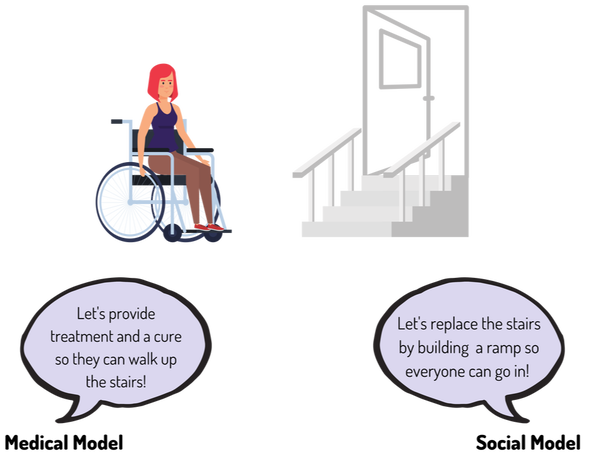
            Medical Model of Disability
  • ​Viewed as a medical issue or diagnosis, an individual is limited to and defined by his/her impairment(s)
  • Emphasis on use of medical intervention to cure and "fix the problem
  • Led to stereotyping and degrading of people based on their medical or biological dysfunction
​

​Social Model of Disability
  • Focuses on how society creates and perpetuates systemic barriers, discrimination, and exclusion of individual differences 
  • Accessibility through accommodations and universal inclusion/design
  • Society fails to include disabled individuals, a minority group oppressed by those who are able-bodied
Picture

Issues with the models

​Although the social model of disability allows us to take account of the accommodations and necessary barrier removals for disabled individuals to live full, independent lives, everyone does occasionally require medical care. Specifically with progressive, chronic, or painful conditions, medical interventions may be imperative to maintain freedom and livelihood. The social model of disability’s focus on larger societal effects can lead to the inattention towards individual impairments that may need to be addressed (2). More nuanced models of disability should be developed to recognize both society’s impacts and the people’s individual functional impairments.

flsdkjfs

Applying the Social Model to Medicine

Given the pervasiveness of the medical model of disability in the medical field, how can medical professionals increasingly integrate the social model of disability into practice for greater inclusion of disabled individuals in society? Dr. Sara Goering proposes the need for increased stigma-free discussion regarding negative impairment effects which involves greater education on disability rights and disability pride (3). Challenging the predominant narrative surrounding disability requires the practice of close listening and a creative patient-centered approach for the greatest possible inclusion and accommodation. Ideally, medical professionals can sympathize with the disability rights movement but also utilize their medical expertise to facilitate the detrimental effects of a disabled individual’s impairments.

Previous Page
Next Page
Sources
(1)Hogan, A. J. (2019). Social and medical models of disability and mental health: Evolution and renewal. CMAJ : Canadian Medical Association Journal, 191(1), E16–E18. https://doi.org/10.1503/cmaj.181008
(2)Linker, B. (2013). On the borderland of medical and disability history: A survey of the fields. Bulletin of the History of Medicine, 87(4), 499–535. https://doi.org/10.1353/bhm.2013.0074
(3)​Goering, S. (2015). Rethinking disability: The social model of disability and chronic disease. Current Reviews in Musculoskeletal Medicine, 8(2), 134–138. https://doi.org/10.1007/s12178-015-9273-z

Powered by Create your own unique website with customizable templates.
  • Home
  • About
  • Disabilities and Neurodiversity
    • Disability and Neurodiversity Facts
  • Centering Disabled Voices
    • A Conversation about Health Experiences and Campus Advocacy
    • A Conversation about Disability Health Research, Identity, and Visibility
  • Models of Disability
  • Quality of Life
  • Power Dynamics
    • A Case of Power in Question
  • American Disabilities Act
  • Labels and the Language we Use
  • Autism Spectrum Disorder
    • A Conversation about Autism Research, AASPIRE, and Inclusivity
  • Mental Health
    • Comorbidities and ASD
    • A Conversation about Accommodations, Therapy, and Stigma
    • A Conversation about Mental Health and Trauma
  • Transitioning from Childhood to Adulthood
    • A Conversation on NOT Making Assumptions and the Lack of Resources
  • The Insurance Costs
    • Retaining Independence and Control
  • Disabilities in COVID-19