Ability to Care
  • Home
  • About
  • Disabilities and Neurodiversity
    • Disability and Neurodiversity Facts
  • Centering Disabled Voices
    • A Conversation about Health Experiences and Campus Advocacy
    • A Conversation about Disability Health Research, Identity, and Visibility
  • Models of Disability
  • Quality of Life
  • Power Dynamics
    • A Case of Power in Question
  • American Disabilities Act
  • Labels and the Language we Use
  • Autism Spectrum Disorder
    • A Conversation about Autism Research, AASPIRE, and Inclusivity
  • Mental Health
    • Comorbidities and ASD
    • A Conversation about Accommodations, Therapy, and Stigma
    • A Conversation about Mental Health and Trauma
  • Transitioning from Childhood to Adulthood
    • A Conversation on NOT Making Assumptions and the Lack of Resources
  • The Insurance Costs
    • Retaining Independence and Control
  • Disabilities in COVID-19
  • Home
  • About
  • Disabilities and Neurodiversity
    • Disability and Neurodiversity Facts
  • Centering Disabled Voices
    • A Conversation about Health Experiences and Campus Advocacy
    • A Conversation about Disability Health Research, Identity, and Visibility
  • Models of Disability
  • Quality of Life
  • Power Dynamics
    • A Case of Power in Question
  • American Disabilities Act
  • Labels and the Language we Use
  • Autism Spectrum Disorder
    • A Conversation about Autism Research, AASPIRE, and Inclusivity
  • Mental Health
    • Comorbidities and ASD
    • A Conversation about Accommodations, Therapy, and Stigma
    • A Conversation about Mental Health and Trauma
  • Transitioning from Childhood to Adulthood
    • A Conversation on NOT Making Assumptions and the Lack of Resources
  • The Insurance Costs
    • Retaining Independence and Control
  • Disabilities in COVID-19

American Disabilities Act

​The American Disabilities Act (ADA) is a federal civil rights law enacted in 1990 that prohibits discrimination against people with disabilities in everyday activities, including health services (1). 
Both public (government organizations like state and local entities) and private (business and nonprofit organizations like BlueCross) providers fall under Title II and Title III of the ADA, respectively. They are both required to provide full and equal access to their health care services and facilities. This includes but is not limited to sign language interpreters, having enough space inpatient rooms for wheelchairs to turn, or accessible digital communication. Section 504 of the Rehabilitation Act of 1973 covers those that receive federal financial assistance, including Medicare and Medicaid. 

Picture
Provide reasonable changes to policies and practice
​

Ex: Modifying a policy that requires patients to fill out their own paperwork and allowing extra time for staff to help complete paperwork for persons requesting assistance
Provide effective means to communicate through services
​

​​Ex: For a person with low vision, providing discharge instructions and medication management in large print and a qualified reader for text information
Provide Accessible Facilities
​

Ex: Clear pathways to rooms (no objects protruding), doors with lever handles, sensory supportive environments

​Learn more about Increasing Accessibility under the ADA.

Publicly Funded Health Care (Type II)

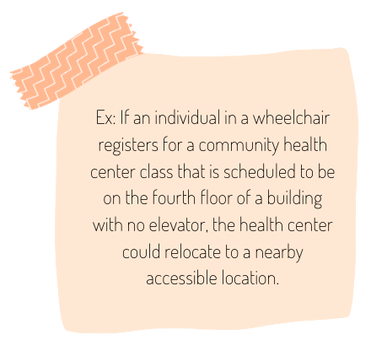
  • Make all health care programs and services available to disabeled individuals
  • If individual programs are not accessible, services can be reallocated to an accessible location or provided in a different way
Picture

Privately Funded Health Care (Type III)
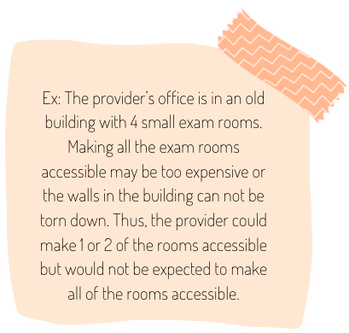
  • Must take steps towards removing barriers to achieve complete accessibility
  • If reasonable modification or providing effective communication can be proven to be too expensive or completely change the care provided, compliance not required
Picture

Where the ADA Falls Short

​Though the ADA seeks to improve access and eliminate societal constructed barriers, our health system is increasingly complex and can be constantly improved upon. For example, the guidelines for private organizations to take steps toward removing barriers does not convey a sense of urgency. In fact the words “readily achievable,” meaning easy to accomplish, in the ADA conveys the exact opposite. There need to be systems in place to reward or encourage groups to demonstrate progress in increasing accessibility. In addition, there is a lack of data collection or research on disabled groups to allow for more focused advocacy, legislation, and amendments. Most importantly, there is no one size fits all approach, accommodations rely on close listening and open-mindedness towards each individual’s needs.
Previous Page
Next Page
Sources
(1)​ https://adata.org/factsheet/health-care-and-ada

Powered by Create your own unique website with customizable templates.
  • Home
  • About
  • Disabilities and Neurodiversity
    • Disability and Neurodiversity Facts
  • Centering Disabled Voices
    • A Conversation about Health Experiences and Campus Advocacy
    • A Conversation about Disability Health Research, Identity, and Visibility
  • Models of Disability
  • Quality of Life
  • Power Dynamics
    • A Case of Power in Question
  • American Disabilities Act
  • Labels and the Language we Use
  • Autism Spectrum Disorder
    • A Conversation about Autism Research, AASPIRE, and Inclusivity
  • Mental Health
    • Comorbidities and ASD
    • A Conversation about Accommodations, Therapy, and Stigma
    • A Conversation about Mental Health and Trauma
  • Transitioning from Childhood to Adulthood
    • A Conversation on NOT Making Assumptions and the Lack of Resources
  • The Insurance Costs
    • Retaining Independence and Control
  • Disabilities in COVID-19